
Safety and Precautionary Measures in a Lube Oil Blending Plant: A Process-Engineering Guide to HSE Design and Operation

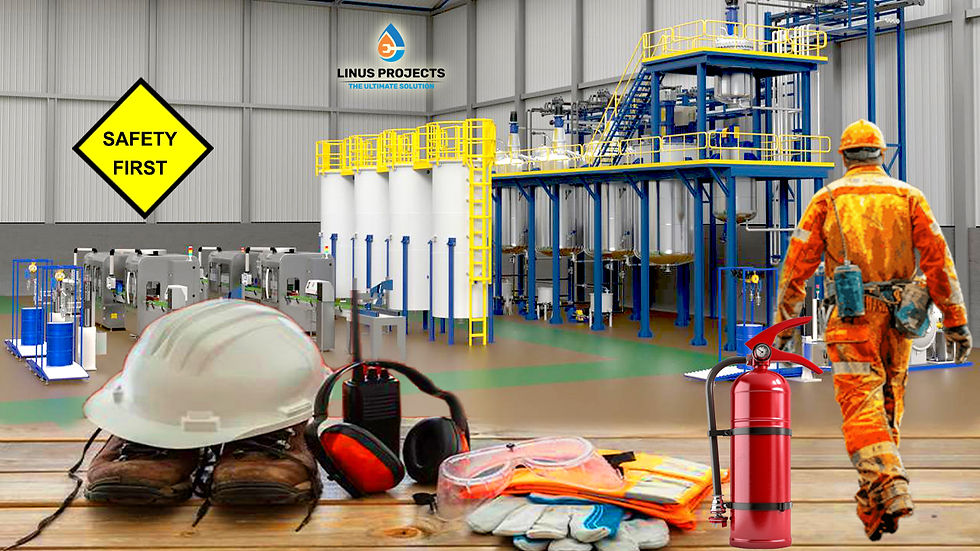
Most people assume a lubricant is a benign, low-risk material — and on the shelf, in a sealed pack, it largely is. Inside a working lube oil blending plant, however, that same product passes through heating, agitation, transfer, filtration, and filling stages, where energy, temperature, and human interaction converge. It is precisely this combination that turns an otherwise stable combustible liquid into a process that demands disciplined safety engineering. The flash point of a finished mineral base oil may sit comfortably above 200 °C, yet a fine oil mist, an ungrounded transfer line, an over-temperature thermic-fluid heater or a poorly executed tank entry can each defeat that comfort margin in seconds.
At LINUS PROJECTS (INDIA), every blending plant we engineer is treated first as a safety system and only second as a production asset. This guide sets out, in practical engineering terms, the hazards inherent to a lube oil blending plant and the precautionary measures that contain them — from design-stage decisions to day-to-day operating discipline. It is written for plant owners, project managers, HSE officers and operators who want more than a generic checklist.
Why a Lube Oil Blending Plant Carries Real, Often Under-Estimated Risk
The risk profile of a blending plant is unusual because the bulk material behaves so differently from the way it can behave once dispersed or heated. Three characteristics explain why complacency is dangerous.
First, base oils are combustible rather than highly flammable. They do not flash at ambient temperature, so they earn a relatively forgiving classification. But the plant routinely warms them to dissolve additives and viscosity-index improvers, narrowing the gap between operating temperature and flash point, especially when localised hot spots form around heating coils or near a hot-oil header.
Second, a liquid that refuses to ignite as a pool will ignite readily as an aerosol. Oil mist with droplets in the low-micron range presents a far lower effective ignition threshold than the bulk liquid, and mist is generated wherever oil is sprayed, splashed, drained from height or released from a leaking pressurised joint. The lower explosive concentration of such a mist can be reached inside an enclosed space without any obvious warning.
Third, the additive side of the plant introduces chemistry that the base oil alone does not. Detergent and dispersant packages, anti-wear chemistries such as Zinc dialkyl dithiophosphates (ZDDPs), sulphur- and phosphorus-bearing compounds, amines and the occasional low-flash carrier solvent each carry their own toxicity, reactivity or volatility. The plant is therefore never “just oil.”
Recognising these three realities is the foundation of every control measure that follows.
Mapping the Hazards: What Actually Goes Wrong
A rigorous hazard map is the starting point of any credible safety programme. The principal hazard families in a lube oil blending plant are set out below.
Fire and Explosion
Ignition sources include hot surfaces, electrical equipment in vapour-prone areas, static discharge during transfer, hot-work sparks and the heating media themselves. Fuel sources include base oil and additive vapours near heated equipment, oil mist, drained product and any low-flash solvents on site. Where a fuel source and an ignition source share the same space — a drum-decanting bay, a filling head, a vent outlet, a sump — the conditions for a fire or a mist explosion exist.
Thermal and Hot-Oil Hazards
Thermic-fluid (hot-oil) heaters operate at bulk temperatures in the region of 250–300 °C, and the headers, jackets, coils and traced lines that distribute this heat remain hot enough to cause severe burns on contact and to ignite a leak of the heat-transfer fluid itself. Hot product splashing during sampling, charging or filling is a frequent, under-reported cause of injury.
Chemical Exposure
Operators handling additive concentrates and process chemicals face skin contact, inhalation of vapour or mist, and eye exposure. Prolonged or repeated dermal contact with mineral oils is a recognised cause of occupational dermatitis, and certain base stocks can liberate hydrogen sulphide or other dissolved gases when heated or agitated.
Mechanical and Rotating Equipment
Blender agitators, inline mixers, transfer pumps and metering units present entanglement, crushing and shearing hazards. Pressurised lines and vessels add the risk of stored-energy release if isolation and depressurisation are not properly executed before maintenance.
Confined Space
Blending vessels and storage tanks are confined spaces in the strict sense — restricted entry and egress, the potential for oxygen deficiency, and the possible accumulation of flammable or toxic atmospheres. Tank cleaning and internal inspection are among the highest-consequence activities the plant ever performs.
Static Electricity
The transfer, splash-filling and filtration of low-conductivity oils generate and accumulate electrostatic charge. If that charge finds a spark gap in a vapour- or mist-laden atmosphere, it becomes an ignition source the o#096B1Cperator never sees.
Slips, Spills and Working at Height
Oil on a walking surface is among the most common causes of lost-time injury in any lubricant facility, and tank-top platforms, gauging points and elevated charging hatches introduce fall hazards that must be managed independently of the process risk.
Engineering the Hazard Out: Design-Stage and Inherent Safety
The cheapest and most reliable safety control is the one designed into the plant before a single drum is decanted. Inherent and engineered safeguards remove or reduce the hazard rather than relying on a person to behave correctly under pressure.
Hazardous-area classification. Each section of the plant is assessed for the likelihood and persistence of a flammable atmosphere and classified accordingly, following the zoning approach of IEC 60079-10-1 (mirrored in Indian practice by IS 5572) and, for European-scope projects, the ATEX framework. Drum-decanting bays, low-flash material stores, filling heads and vent outlets are the locations most likely to warrant classification; within any classified zone, only certified flameproof or intrinsically safe equipment is permitted.
Layout and separation. Heating equipment is positioned away from product storage and decanting operations, and the plant is laid out so that a leak or fire in one area does not propagate to another. Adequate access for emergency response and equipment isolation is designed in, not retrofitted.
Containment and bunding. Tank farms and key process areas are kerbed and bunded to retain at least the full volume of the largest vessel plus a freeboard allowance, typically sized for 110% containment, so that a tank failure becomes a contained event rather than a site-wide release reaching drains, soil or watercourses.
Heating-system safeguards. A thermic-fluid system is protected by flame-failure detection, high-temperature trips, low-flow and low-level interlocks, an adequately sized expansion vessel and over-temperature cut-outs. Product is heated only to the minimum temperature the blend chemistry requires — for most formulations a working range of roughly 50–70 °C — keeping a wide and deliberate margin below the flash point at all times.
Overfill and level protection. Storage and blending vessels are fitted with independent high and high-high level instrumentation, audible and visible alarms, and trip logic that closes the inlet before overflow can occur. Vents are protected with breather valves and, where appropriate, flame arrestors.
Controlling Static Electricity — a Discipline in Its Own Right
Because electrostatic ignition is invisible, silent and entirely preventable, it deserves separate attention. The controls are well established and follow the logic of recognised practice such as API RP 2003.
Every tank, pump, pipe, filter housing, drum and filling nozzle in the transfer path is electrically bonded together and grounded to a common earth, so that no two conductive items can sit at different potentials and arc across a gap. Fill velocities are limited — particularly during the initial, splash-prone phase of filling a vessel — to restrain the rate of charge generation, and bottom or dip-pipe filling is preferred over free-fall splash filling wherever practicable. A relaxation period is allowed after filtration and before sampling or gauging, giving accumulated charge time to dissipate. Conductive or dissipative flooring, antistatic footwear and, where the product chemistry allows, antistatic additives complete the defence.
These measures cost very little and prevent an entire category of catastrophic events.
Fire Detection, Protection and Suppression
A blending plant’s fire strategy is layered: detect early, contain locally, and provide the means to fight a developing fire safely. Detection typically combines heat and smoke sensing in enclosed process and storage areas with manual call points throughout. Fixed protection is matched to the hazard — foam systems and foam-water sprinklers are suited to hydrocarbon pool fires, while a ring main with hydrants and monitors provides bulk water for cooling and exposure protection. Portable extinguishers are distributed and rated for the materials present, with foam and dry-chemical units for hydrocarbon fires and carbon-dioxide units around electrical equipment. The entire scheme is designed and spaced in line with codes such as NFPA 30 for flammable and combustible liquids and, for Indian installations, the relevant Oil Industry Safety Directorate (OISD) standards, supported by a Fire No-Objection Certificate from the local authority.
Procedural Safety: Permit-to-Work and Standard Operating Procedures
Engineered safeguards reduce risk; procedures govern the moments when those safeguards are deliberately bypassed for maintenance, modification or non-routine work. A formal permit-to-work system is the backbone of operational safety in any blending plant, and the core permits are:
Hot-work permit — for welding, grinding, cutting or other spark-producing activity, issued only after the area is gas-tested, cleared of combustibles, and provided with a fire watch and standby extinguishers.
Confined-space entry permit — for any entry into a tank, vessel or pit, conditional on atmospheric testing, isolation, ventilation and rescue provision.
Lockout-Tagout (LOTO) / electrical and mechanical isolation — to positively isolate and de-energise equipment before maintenance, preventing inadvertent start-up or stored-energy release.
Work-at-height permit — for activity on tank tops, platforms and elevated charging points, with fall-protection requirements specified.
Line-breaking permit — for opening any pipe or vessel that has contained product or pressure, ensuring depressurisation and draining before the joint is broken.
Alongside permits sit the routine standard operating procedures — for additive charging sequence, blending, sampling, filtration and pack filling — that codify the correct, safe method for everyday tasks and remove reliance on memory or improvisation.
Personal Protective Equipment
PPE is the last line of defence, never the first, but in a blending plant it is indispensable. The baseline kit for routine operations includes oil-resistant and antistatic safety footwear, chemical-resistant (typically nitrile) gloves for additive and chemical handling, heat-resistant gloves and aprons for hot-product tasks, safety goggles or a face shield against splash, and flame-retardant clothing in classified or hot-work areas. Respiratory protection is provided wherever oil mist or vapour cannot be fully controlled at source, and the correct grade of cartridge or supplied-air system is specified for the exposure. PPE is matched to the task and to the material’s safety data sheet, which is kept accessible at the point of use.
Confined-Space Entry: The Highest-Consequence Activity
Because tank and vessel entry concentrates so much risk, it warrants its own rigorous regime. Before any entry, the vessel is drained, cleaned and purged of residual product and vapour, then mechanically and electrically isolated from all connected systems. The internal atmosphere is tested for oxygen content, flammable vapour (lower-explosive-limit reading) and relevant toxic gases, and forced ventilation is established and maintained throughout. A trained standby attendant remains outside in continuous communication with the entrant, and a rehearsed rescue plan with appropriate retrieval equipment is in place before entry begins. No entry proceeds on assumption; every parameter is verified, recorded on the permit and re-checked at defined intervals.
Spill Control, Drainage and Housekeeping
Good housekeeping is not cosmetic — in an oil plant it is a primary safety control, because a clean, dry, uncluttered floor prevents slips, removes incidental fuel and keeps escape routes open. Drip trays under pumps, valves and filling points capture routine drips; spill kits with absorbent and containment booms are positioned for rapid response; and contaminated wash-down and accidental spillage are routed through an oil-water interceptor or separator before discharge, protecting both the workforce and the environment. A discipline of clean-as-you-go, prompt spill response and orderly drum and pack storage underpins the entire safety system.
Statutory and Code Compliance
Safety in a lube oil blending plant is also a legal obligation, and a compliant plant is, by design, a safer plant. Depending on location and the materials handled, the applicable framework typically includes: the Factories Act and the relevant State Factories Rules governing workplace safety; the Petroleum Rules and licensing through the Petroleum and Explosives Safety Organisation (PESO) where petroleum-class materials are stored; the Manufacture, Storage and Import of Hazardous Chemicals Rules were notified chemicals are present; Pollution Control Board consents for emissions and effluent; and a Fire No-Objection Certificate. Internationally recognised codes — NFPA 30, the IEC 60079 series and ATEX for hazardous areas, and OISD standards for oil-industry installations — provide the engineering benchmarks against which the plant is designed and audited. Compliance is treated as a living obligation, maintained through periodic inspection, testing and recertification rather than a one-time clearance.
Training, Emergency Preparedness and Safety Culture
The most thoroughly engineered plant is only as safe as the people who operate it. A credible programme therefore invests in HSE induction for every new worker, regular toolbox talks tied to the specific tasks of the day, and competency-based training for high-risk activities such as hot work and confined-space entry. Emergency preparedness is rehearsed, not merely documented: fire and evacuation drills, clearly marked assembly points, accessible first-aid provision, and strategically placed eyewash stations and emergency safety showers near additive-handling and sampling points. Above all, a culture in which any worker can stop a job they believe is unsafe — without fear of reprisal — converts written procedures into lived behaviour, and is the single most reliable predictor of a plant’s long-term safety record.

How LINUS PROJECTS (INDIA) Builds Safety into Every Blending Plant
For LINUS PROJECTS (INDIA), safety is not a clause appended to a contract — it is the organising principle of the way we engineer, supply and commission lube oil blending plants for clients across India, West Africa and the Middle East. From hazardous-area classification and bunded layouts to interlocked heating systems, bonded transfer circuits, code-compliant fire protection and operator training, each project is delivered as an integrated safety system. As an ISO 9001:2015-certified turnkey EPC partner, we bring the same discipline to a 25 MT/day plant as to a multi-line export installation, because the consequences of a shortcut do not scale down.
If you are planning a new lube oil blending plant, expanding an existing facility, or seeking an independent safety and compliance review of your current operation, our engineering team can help you build a plant that protects your people, your product and your licence to operate.
Frequently Asked Questions
Is lube oil flammable in a blending plant?
Finished base oils are classified as combustible rather than highly flammable, because their flash point is well above ambient temperature. The risk in a blending plant arises from heating the oil, generating oil mist, handling lower-flash additives or solvents, and allowing ignition sources such as static discharge or hot surfaces into vapour-prone areas. Treating the oil as harmless is the most common and most dangerous mistake.
What are the main fire-safety measures for a lube oil blending plant?
Layered detection (heat and smoke sensing plus manual call points), fixed suppression suited to hydrocarbon fires (foam systems, a hydrant and monitor ring main), correctly rated portable extinguishers, control of ignition sources through hazardous-area equipment and bonding, and a permit-to-work system governing all hot work — all designed in line with codes such as NFPA 30 and applicable OISD standards.
Why is static electricity dangerous when blending lubricants?
Low-conductivity oils accumulate electrostatic charge during transfer, splash-filling and filtration. If that charge discharges as a spark in a mist- or vapour-laden atmosphere, it can ignite a fire that the operator never sees coming. Bonding and grounding every item in the transfer path, limiting fill velocities and allowing relaxation time after filtration are the established controls.
What PPE is required in a lube oil blending plant?
At minimum: oil-resistant antistatic safety footwear, chemical-resistant gloves for additive handling, heat-resistant gloves and aprons for hot-product tasks, eye protection against splash, flame-retardant clothing in classified areas, and respiratory protection wherever oil mist or vapour cannot be controlled at source — always matched to the material’s safety data sheet.
What precautions apply to entering a blending tank or storage vessel?
Tank entry is a confined-space activity requiring the vessel to be drained, cleaned, purged and isolated; the atmosphere tested for oxygen, flammable vapour and toxic gases; continuous forced ventilation; a permit-to-work; a standby attendant; and a rehearsed rescue plan with retrieval equipment in place before entry begins.


Comments