
Key Insights into Lube Oil Blending Process Optimization

Updated: Jan 8
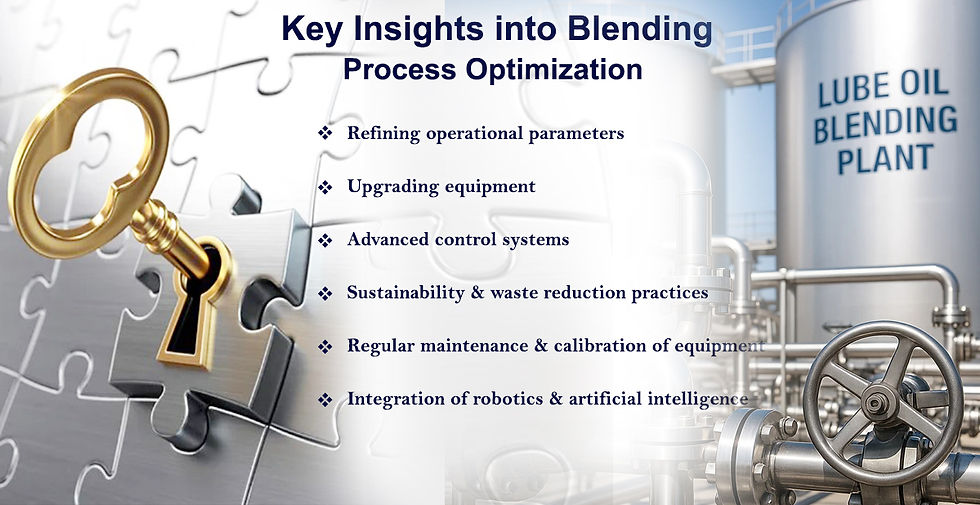
The production of high-quality lubricants requires a thorough understanding of the lube oil blending process. This process involves the precise combination of base oils and additives to achieve desired performance characteristics. In this article, I will explore the critical aspects of lube oil blending process optimisation, providing detailed insights into the technical considerations, equipment requirements, and quality control measures essential for efficient manufacturing. The goal is to provide practical guidance for businesses looking to improve their lubricant and grease manufacturing operations.
Understanding the Fundamentals of Lube Oil Blending
Lube oil blending is a complex chemical engineering operation that demands accuracy and consistency. The process begins with the selection of appropriate base oils, which serve as the primary fluid medium. These base oils are typically mineral oils, synthetic oils, or a blend of both. The choice depends on the intended application and performance requirements.
Additives are then incorporated to improve properties such as viscosity, oxidation resistance, corrosion inhibition, and anti-wear characteristics. The blending must be conducted under controlled conditions to ensure homogeneity and stability of the final product.
Key parameters influencing the blending process include temperature, mixing speed, and order of addition. For example, certain additives require dissolution at elevated temperatures to achieve proper dispersion. Failure to maintain these parameters can result in phase separation or inadequate performance.
The blending process is often monitored using analytical techniques such as viscosity measurement, flash point testing, and spectroscopic analysis. These tests confirm that the lubricant meets industry standards and customer specifications.

Blending Process Optimisation: Enhancing Efficiency and Quality
Optimisation of the lube oil blending process is essential to maximise production efficiency and product quality. This involves refining operational parameters, upgrading equipment, and implementing advanced control systems.
Automation: Automated systems can precisely control the addition of base oils and additives, monitor temperature and mixing speed, and adjust parameters in real time. This reduces human error and improves repeatability.
Tanks & Mixers: Another critical aspect is the selection of blending tanks and mixers. Tanks constructed from corrosion-resistant materials and equipped with variable-speed agitators enable better control over the blending environment. Proper tank design minimises dead zones and ensures uniform mixing.
Quality Control & Sensors: Process optimisation also includes the implementation of robust quality control protocols. Inline sensors and sampling systems enable continuous monitoring of product properties, allowing for immediate corrective actions in the event of deviations.
Reduce Energy Costs: Energy consumption is another factor to consider. Optimising mixing times and temperatures can reduce energy costs without compromising product quality. For instance, preheating base oils to the optimal temperature before blending can shorten mixing duration.
The integration of these optimisation practices is aligned with the objectives, which aim to establish a dominant position in the global market for lube oil blending and grease-making plants, helping clients to achieve the highest levels of production efficiency and to grow their international presence.
Key Equipment and Technology in Lube Oil Blending Plants
The selection and maintenance of equipment are pivotal in achieving efficient lube oil blending. The primary components include storage tanks, blending vessels, dosing systems, and filtration units.
Storage Tanks must be capable of handling a variety of base oils and additives, often requiring temperature regulation to preserve fluidity. Blending vessels are designed to facilitate thorough mixing, typically featuring agitators with adjustable speeds and baffles to enhance turbulence.
Dosing Systems are responsible for accurate measurements and the addition of additives. Precision pumps and flow meters ensure that the correct quantities are introduced, which is critical for maintaining product specifications.
Filtration Systems remove contaminants and particulates that could affect lubricant performance. Filters with appropriate micron ratings are selected based on the type of base oil and additives used.
Advanced plants may incorporate real-time monitoring technologies such as near-infrared (NIR) spectroscopy and automated sampling. These tools provide immediate feedback on blend composition and quality, enabling users to make proactive adjustments.
Regular Maintenance and calibration of equipment are necessary to sustain optimal performance. Scheduled inspections and cleaning prevent contamination and mechanical failures.

Quality Control and Regulatory Compliance in Lube Oil Blending
Maintaining stringent quality control is indispensable in the lube oil blending industry. The final product must comply with international standards such as API (American Petroleum Institute) classifications and OEM (Original Equipment Manufacturer) requirements.
Quality control begins with the inspection of raw materials. Base oils and additives are tested for purity, viscosity, and other relevant properties before they are accepted. Any deviation can compromise the entire batch.
During blending, samples are taken at various stages to monitor parameters like viscosity index, pour point, flash point, and total base number (TBN). These tests ensure that the blend meets the targeted specifications.
Once blending is complete, the lubricant is evaluated through stability tests to gauge its performance in various environmental settings. This assessment includes thermal stability, resistance to oxidation, and compatibility with engine components.
Documentation and traceability are also critical. Detailed records of raw materials, batch formulations, process parameters, and test results must be maintained to satisfy regulatory audits and customer requirements.
Implementing a comprehensive quality management system, such as ISO 9001, supports consistent product quality and continuous improvement.
Strategies for Scaling Up Lube Oil Blending Operations
Scaling up production in lube oil blending plants requires careful planning and execution. The transition from pilot-scale to full-scale manufacturing involves challenges related to equipment capacity, process control, and supply chain management.
One approach is modular plant design, which allows incremental expansion by adding blending units as demand grows. This flexibility reduces initial capital expenditure and facilitates maintenance.
Process simulation and modelling tools can predict the behaviour of blends at larger volumes, helping to optimise parameters before physical scale-up. This reduces trial-and-error and minimises downtime.
Supply chain coordination is essential to ensure the timely availability of base oils and additives. Establishing reliable supplier relationships and inventory management systems minimises production delays.
Training of personnel on new equipment and procedures is necessary to maintain operational efficiency and safety during scale-up.
By adopting these strategies, businesses can increase production capacity while maintaining product quality and operational efficiency.
Future Trends in Lube Oil Blending Technology
The lube oil blending industry is evolving with advancements in technology and changing market demands. Emerging trends include the use of environmentally friendly base oils, digitalisation, and enhanced automation.
Bio-based and synthetic base oils are gaining prominence due to their superior performance and lower environmental impact. Blending processes must adapt to handle these new materials, which may have different physical and chemical properties.
Digital technologies such as Industry 4.0 enable real-time data analytics, predictive maintenance, and remote monitoring. These capabilities improve process control and reduce operational costs.
Automation continues to advance with the integration of robotics and artificial intelligence, allowing for more precise and flexible blending operations.
Sustainability considerations are driving innovations in energy-efficient equipment and waste reduction practices.
Staying abreast of these trends is crucial for businesses aiming to maintain competitiveness and meet evolving regulatory requirements.
Advancing Production Capabilities with Expert Project Management
The successful implementation of lube oil blending plants depends not only on technical expertise but also on effective project management. Coordinating design, procurement, construction, and commissioning activities requires a structured approach.
Expert project management ensures that timelines, budgets, and quality standards are met. It also facilitates communication among stakeholders and addresses potential risks proactively.
Companies specialising in turnkey project management, such as LINUS PROJECTS (INDIA), provide comprehensive solutions that encompass engineering design, equipment supply, installation, and after-sales support.
By leveraging such expertise, businesses can accelerate their production capabilities, optimise resource utilisation, and expand their international footprint efficiently.
Conclusion: The Path to Efficient Lube Oil Blending
This detailed examination of the lube oil blending process optimisation highlights the critical factors influencing production quality and efficiency. By integrating advanced technologies, rigorous quality control, and strategic project management, businesses can achieve superior outcomes in lubricant manufacturing.
The journey toward optimising lube oil blending processes is ongoing. Continuous improvement and adaptation to new technologies will be essential for maintaining competitiveness in the global market.
For more information on enhancing your lubricant and grease manufacturing plants, consider exploring the resources available at LINUS PROJECTS (INDIA)



Comments